How to Calculate Casting Cost per Kg: A Practical Foundry Guide
 Cost per kg

Casting cost per kg is the total manufacturing cost of a batch divided by the saleable casting weight, not the metal melted. Include net metal and alloys, melting energy, moulding consumables, labour, finishing, inspection, rejection and overheads. For example, ₹2,00,000 of batch cost over 800 kg of good castings is ₹250 per kg.
- Formula
- Cost per kg = Total manufacturing cost ÷ Saleable casting weight
- Cost components
- Metal, energy, moulding, labour, rejection, overheads
- Use it for
- Quotations, item-wise profitability, cost control
What is metal casting cost?
Metal casting cost is the total cost of making a casting that meets the customer's specification. Depending on the process and the level of costing you need, it includes:
- Raw metal and alloying materials
- Melting and pouring energy
- Moulding sand, binders, cores and other consumables
- Direct labour
- Pattern and tooling cost
- Fettling, finishing and machining
- Inspection and testing
- Rejection, rework and material losses
- Maintenance and factory overheads
The exact structure depends on the material, the component design, volumes, the process route and customer requirements.
What is the casting cost per kg formula?
Use saleable weight because rejected castings also consume metal, energy, labour and consumables. If 1,000 kg is produced and only 950 kg passes inspection, divide the total cost by 950 kg, not 1,000 kg. Dividing by the melted or poured weight makes every casting look cheaper than it is.
What are the six components of casting cost?
1. Raw material cost
Take the metal actually consumed, including process losses, and subtract the value of returns you can re-melt, such as runners, risers and rejected castings.
Use actual consumption and recovery data, not standard figures. Casting yield drives this number; see how to calculate casting yield.
2. Melting and energy cost
Electricity or fuel used for melting and holding. Track it heat by heat or batch by batch so you can see energy per kg of metal melted.
3. Moulding and consumables
Moulding sand, core sand, binders, refractories, coatings and finishing consumables.
4. Labour and processing
Mould preparation, pouring, fettling, finishing, machining and inspection.
5. Rejection and rework
Rejected castings and rework add cost without adding saleable output.
Track rejection by component, heat, defect and stage. Our defect-wise rejection analysis guide shows how.
6. Overheads and tooling
Depreciation, maintenance, indirect labour, utilities, quality-control expenses and pattern or die costs, allocated to the castings that use them.
Worked example: casting cost per kg for one batch
Illustrative figures only. They are not industry benchmarks or recommended rates.
| Cost component | Batch cost |
|---|---|
| Net metal and alloy cost | ₹1,20,000 |
| Melting energy | ₹18,000 |
| Moulding and consumables | ₹12,000 |
| Direct labour | ₹15,000 |
| Finishing and machining | ₹20,000 |
| Quality inspection and testing | ₹5,000 |
| Allocated overheads | ₹10,000 |
| Total batch cost | ₹2,00,000 |
The batch produces 800 kg of saleable castings.
If the selling price is ₹300 per kg, the difference is ₹50 per kg before selling, administration and finance costs, so do not treat it as net profit.
In this example metal is 60% of the cost, which is why charge-mix choices and yield move cost per kg more than anything else.
How can a foundry make casting costing more accurate?
Accurate costing needs reliable production and consumption data. Review these every month:
- Metal consumption and material recovery
- Energy cost per kg of metal melted
- Casting yield and rejection rates
- Labour and machine utilisation
- Actual cost against estimated cost, per component
How does foundry ERP keep item-wise costing accurate?
When costing lives in spreadsheets, actual costs from each stage arrive late, and some never arrive. A foundry ERP captures consumption, energy, labour and rejection where they happen, so cost per kg is calculated from actual data for every heat and every item.
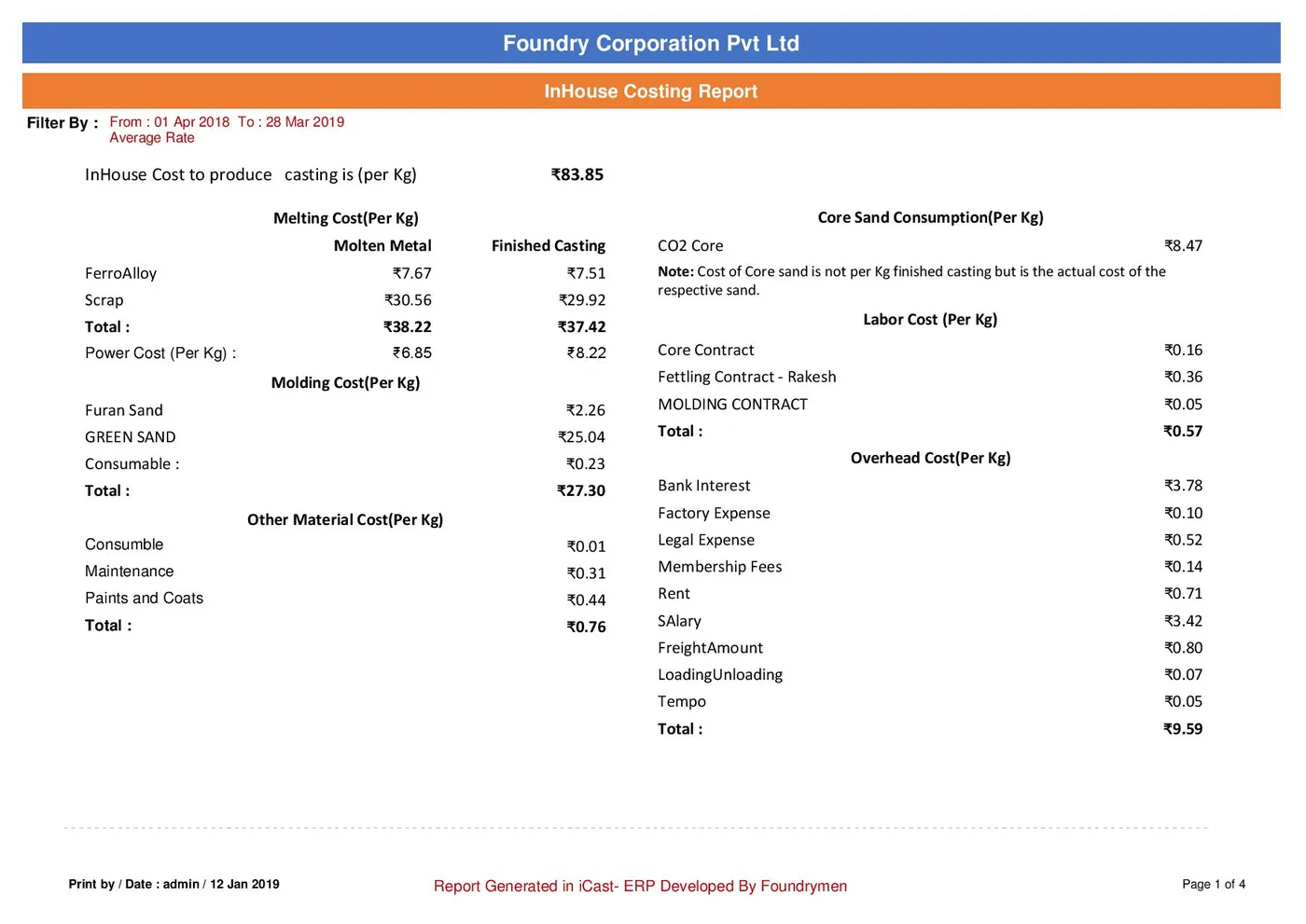
ICAST's item-wise costing and profitability report shows the real cost and margin of every item you cast, so you can find loss-making castings and quote from actual cost. It is part of ICAST Pro and can be added to ICAST Lite as a module. Combined with Meltix least-cost charge mix, which customers have measured at up to 4% lower charge cost for iron, 6% for aluminium and copper alloys and 8% for steel, it attacks the biggest line in the table above.
Frequently asked questions
How do you calculate casting cost per kg?
Add up the total manufacturing cost of the batch, including metal, energy, moulding, labour, finishing, inspection, rejection and overheads, and divide it by the weight of saleable castings.
Why divide by saleable weight and not melted weight?
Rejected castings, runners and risers also consume metal, energy and labour. Dividing by saleable weight puts their cost on the castings you actually sell.
Does rejection affect casting cost per kg?
Yes. Every rejected casting adds metal, energy and labour cost without adding saleable weight, so higher rejection raises cost per kg.
What is a normal casting cost per kg?
There is no single benchmark. It depends on the metal, the component, volumes and the process route, so calculate it from your own production data.